I would like to buy software again
Everything became a rental. A test for telling the fees that buy something from the fees that buy permission, and the question you have to ask straight after it.
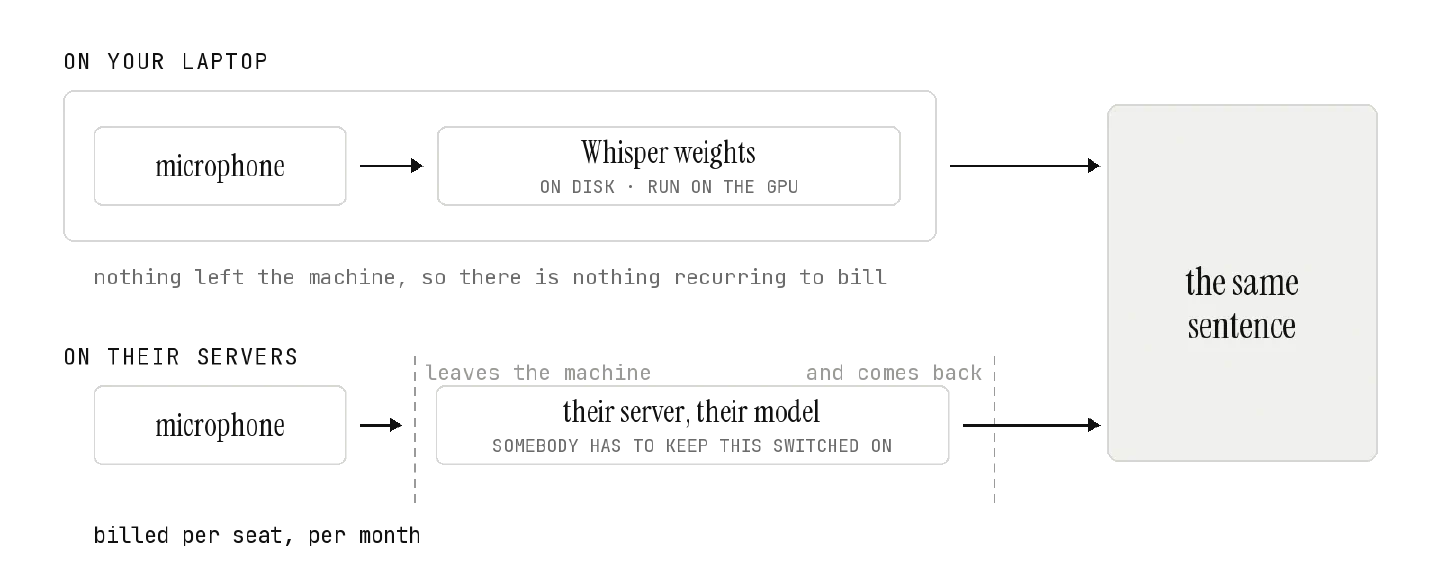
I am dictating this sentence rather than typing it, at normal speaking pace, into a laptop that is doing the transcription itself. The weights sit on the SSD. They were downloaded once, the quantised build is under a gigabyte, and it runs on the GPU of an M1 through Metal. No account. No upload. No monthly fee. The client is open source, and the accuracy is better than I expected.
For about two weeks I have also been served, relentlessly, an advertisement for a product that does the same thing. It is a subscription.
The distance between those two paragraphs is the whole argument.
Everything became a rental
Software you buy once and keep is now the exception. I have to stop and think before I can name examples.
Blackmagic is the one I always land on. Bought directly from them, DaVinci Resolve Studio is $295, paid once, and the price has not moved since 2021. Every update so far has arrived free, point releases and whole new major versions alike.
Two caveats, because this example gets used lazily and I would rather handle them myself. Blackmagic sells cameras, switchers, monitors and capture cards, and Resolve is partly a very good reason to buy them. It is cross-subsidised. Also, the free major upgrade is a track record rather than a promise. Grant Petty said as much at NAB this year, and pointedly did not rule out charging for one eventually.
Neither is fatal. Cross-subsidised is not the same as impossible, and “we would have to change the business” is a different sentence from “it cannot be done.”
Then in September 2025 Blackmagic did something that looks at first like a betrayal of the example. They opened up a rental. Thirty dollars a month for Resolve Studio through Blackmagic Cloud, full features, gone the moment you stop. Break-even against the perpetual licence lands somewhere around ten months.
Renting had existed before that, but only for organisations buying seats in bulk. What changed is that you can now take one on a personal profile, with nothing behind you. It is worth being precise about that, because Blackmagic’s own page still explains the whole thing under a heading about larger companies assigning a hundred licences at once, which is a good way to lose the exact reader it was opened up for.
I have no objection to that whatsoever. I think it is the correct answer. If you are a freelancer who needs Studio for the eight weeks of one job, renting it beats $295. No company account. No seat count. No IT department. The rental sits next to the purchase instead of replacing it. The arithmetic is legible enough that you can work out which one you want. And nobody had to pretend a local video editor is a cloud service in order to justify the fee.
That is the whole ask, and it is worth saying early so the rest of this is not mistaken for a complaint about subscriptions. Renting should be an option. My objection starts where it becomes the only one, or where it arrives disguised as something else.
Microsoft is where the choice technically survives and has been engineered to feel like a mistake. You can buy Office Home 2024 outright for $179.99. Microsoft will also tell you, in writing, that a one-time purchase has no upgrade path to the next release. Its lifecycle page currently lists security patches for that version through October 2029, which is a published date rather than a guarantee. After it, nothing.
Notice what that second half actually is, because I am coming back to it. It is Microsoft pricing the cost of keeping old software alive and putting a date on how long they will absorb it. That is not a trick. It is the most honest number on the page, and it is the thing my own argument nearly missed.
What I object to is the arrangement. A hundred and eighty dollars and a horizon, or a hundred a year and everything as it arrives. Read side by side, those two offers teach a lesson. Ownership is where software goes to stop. That is presented as a fact about how software works. It is a decision about a product line.
Adobe is the exhibit both sides bring
Adobe is where this argument usually goes to die, so let me put the numbers on the table rather than around them.
In May 2013 Adobe announced there would be no CS7, and that Creative Suite 6 was the last perpetual version it would ever release. Before that switch it was already a four-billion-dollar company that had won its category outright. Photoshop was a verb. Perpetual licensing did not stop Adobe from becoming Adobe.
And then the subscription worked, spectacularly. Adobe’s Digital Media segment, which is Creative Cloud and Document Cloud and the part of the company this argument is actually about, closed fiscal 2025 at $17.65 billion, inside a company total of $23.77 billion.
I am not going to pretend that figure is a coincidence, and nobody arguing my side should. Recurring revenue is more predictable. It survives a bad year. It funds a larger engineering organisation than a lumpy two-year release cycle does. And it took the up-front price of a professional toolchain, $699 for Photoshop on its own and four figures for a full suite, down to a monthly number a student can actually carry. That last point is the strongest argument for the model and it usually gets made badly, so let me make it properly. It is real. It let people in who had been locked out. It counts.
There is a second thing the switch fixed that my side tends to skip, so I will not skip it. Creative Suite was one of the most pirated software franchises on earth, and a meaningful share of “Photoshop is a verb” was unpaid. A subscription with an entitlement check converts some of that into revenue in a way a boxed licence never could. Sell something with a high sticker price and a high piracy rate, and the subscription is not only a billing preference. It is enforcement.
But what $17.65 billion measures is how much better subscriptions are for Adobe. It gets offered as evidence for a second claim, that the software got better because of it, and those are not the same statement. One of them is audited. The other one is asserted.
The fee comes first, the architecture second
Here is the mechanism I think is doing the actual damage.
You cannot charge someone every month for a program they install and then simply use. Everyone can feel it. It reads as a toll rather than a price, and the customer works it out within about three months. So the fee needs a justification, and the justification has to be something you run. Servers, sync, storage, accounts. Something on your side of the wire that keeps costing you money for as long as they keep using it.
Sometimes that is honest, because the product was always going to be that. Canva is the clean case, and it is clean for a reason people are snobbish about. Canva was built so that anybody could make a poster. Not designers. Anybody. Being a browser, a shared brand library and a link you send to somebody is not a wrapper around that product. It is the reason it works at all. There is nothing to own there because there was never a program in the first place.
Arc Studio is where I stop being generous. Screenwriting software is a text editor with strict formatting rules and a page count that has to be right. That is the job. Arc Studio also does collaboration, and collaboration is a real service, and I would pay for it in the weeks I am actually in a room with two other writers. Most weeks I am not. Most weeks I am one person typing a scene at midnight, and the sync server is doing precisely nothing on my behalf.
So sell me the editor. Sell me the sync when I need the sync. Yes, there is a free tier, and the free tier is beside the point, because a free tier is not ownership either. The thing I cannot buy at any price is the editor.
Arc Studio lives in the browser, so somebody is about to tell me that of course their machines are running, and that is exactly what I am renting. It is the best defence available. I am coming back to it, because it is also the clearest case of the thing I actually object to.
Canva makes the other half of the point without meaning to. In March 2024 it bought Serif, the company behind Affinity, for around £300 million. Affinity was the loudest counterexample in the business: a professional design suite, sold outright, aimed squarely at people who were tired of renting Adobe. Canva said at the time that the perpetual licence would stay, and that a subscription, if one ever came, would only be an option next to it.
In October 2025 they made Affinity free instead. One app rather than three, no purchase, and the AI features living on a Canva plan. Free is not a betrayal and I will not pretend it is. But look at what is no longer on the table. You cannot buy Affinity. Not because it got too expensive. Because there is nothing to buy. The perpetual licence did not lose an argument. It got acquired.
That is what the mechanism does to everything it touches. Once the recurring fee is the goal rather than the consequence, the architecture bends until it produces one. Features move behind an account that never needed one. A local file becomes a synced document. Work my laptop was doing perfectly well moves onto a machine I do not own, specifically so that not paying can stop it. The billing model ends up designing the software, and it designs it worse.
Subscriptions killed the major version
First the scope, because this does not hold everywhere. What follows is about mature software with low switching costs, sold to individuals. Creative tools, writing tools, utilities. Most of the examples in this essay. In a genuinely contested business category, where a competitor can take the account this quarter and net revenue retention gets scored every month, the discipline is real and probably tighter than a two-year release cycle ever was. That is not the market I am describing. I am describing the one where I am a seat.
If you sell me software once, you have a problem every couple of years. You have to make me open my wallet again for something I already have a working copy of. Small changes will not do it. Polish will not do it. You need a version I can look at and want. That constraint is brutal and it is productive, and it is why the old release cycle produced things people can still name.
If you rent me software, your problem is a different one. You need me not to cancel. In a category I am not seriously shopping around in, that is a far lower bar, and it is cleared by a steady drip. A redesigned panel. A new export preset. An onboarding tour. Twelve months of that and I have paid a full year while carrying a vague, unfalsifiable sense that the product is “being developed.” Sometimes it genuinely is. Often what I am funding is maintenance with a changelog attached.
Two things are true on the other side and I would rather say them than have them said to me. Nobody has to sit on a finished feature for eighteen months waiting for a version to ship it in, and a security fix reaches everyone instead of the subset who upgraded. Second, that brutal constraint is only survivable if you can afford to fail it. For a small studio funding the next version out of the last one’s revenue, “nothing worth buying shipped this year” is not a productive discipline. It is a payroll problem, and two of those in a row ends the company. A recurring floor is a real answer to that. It is the best argument anybody has put to me.
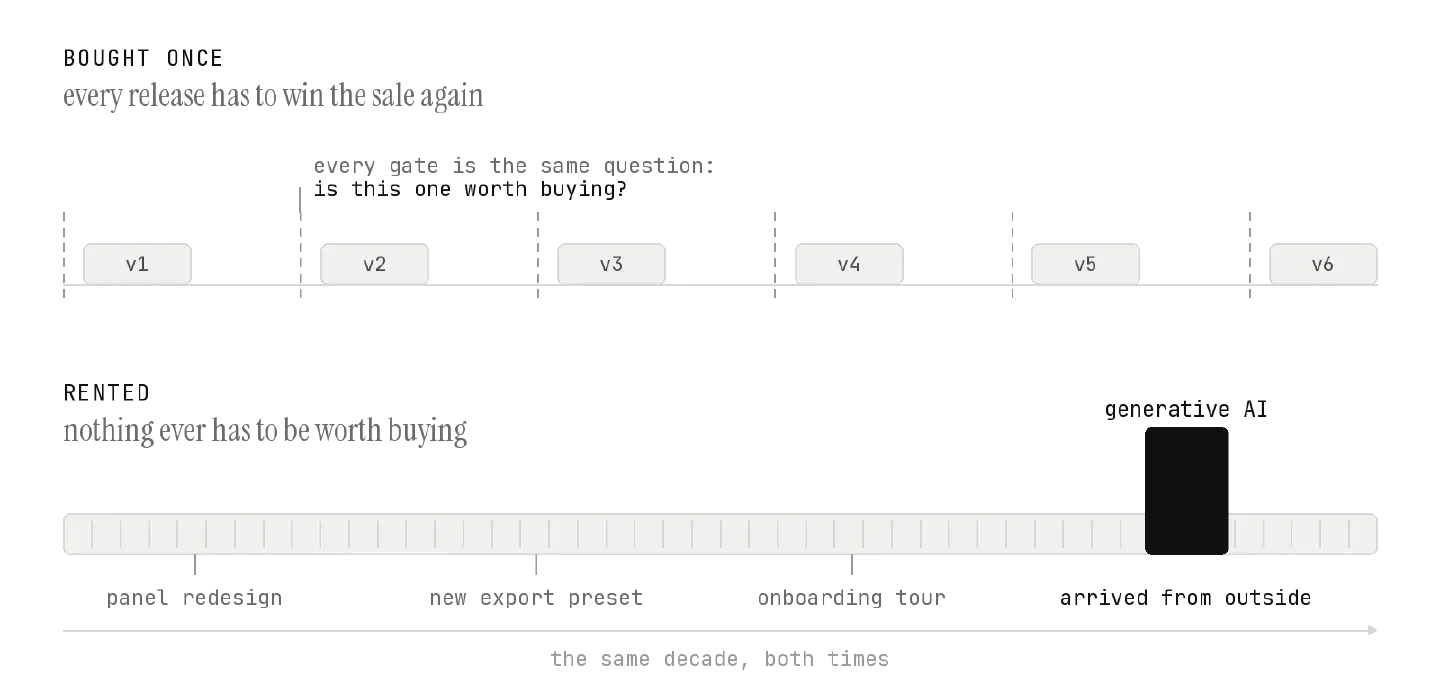
The clearest case for what replaced that pressure is generative AI. Every one of these companies shipped a real change of paradigm inside about eighteen months. Not because the subscription had quietly been funding the research, but because for the first time in years there was a credible chance of customers leaving for whoever had it first. Fear of losing you did in a year and a half what your standing order had not done in ten.
It is not the only case, so let me name the obvious counterexample rather than wait for somebody to hand it to me. Real-time collaborative editing was a genuine paradigm shift. It was born inside the subscription model and could not have existed without one. But it did not come from the incumbents. Figma did not come out of Adobe. It came at Adobe, and Adobe’s answer was not a version, it was a $20 billion cheque. That deal collapsed in December 2023 under UK and EU competition scrutiny, and cost Adobe a $1 billion break fee for the privilege.
That is the pattern. The shifts are real, and they arrive from the companies that do not have the customer yet. Recurring revenue does not appear to produce them. It appears to be what you defend with, once somebody else has.
What actually stops when you stop paying
I am not arguing that subscriptions are illegitimate, and the test I want is not the one I started with.
My first version was simple. When you cancel, does a machine that is not yours stop doing work on your behalf? Storage stops being held. A sync server stops reconciling. A GPU somewhere stops running inference. That is rent on something real.
Good question. Not enough, though, because it only counts costs shaped like hardware. A program that runs entirely on my laptop still costs its author money every year, and none of that money shows up as a server. macOS moves the accessibility permissions that text insertion depends on. Apple ships new silicon. A dependency gets a CVE and somebody’s week disappears into it. Tickets arrive and somebody answers them. Nothing on their side is running for me, and it is still costing them.
Which is exactly what Microsoft was pricing with that 2029 date. A support horizon on a perpetual licence is the maintenance bill, made explicit and given an end.
So the test has two halves, and a fee buys something if it clears either one. Does a machine stop? Does somebody’s week stop? If neither does, and the only thing that ends is my permission to run code already sitting on my disk, then it was never a service. It was a fee for access to my own machine.
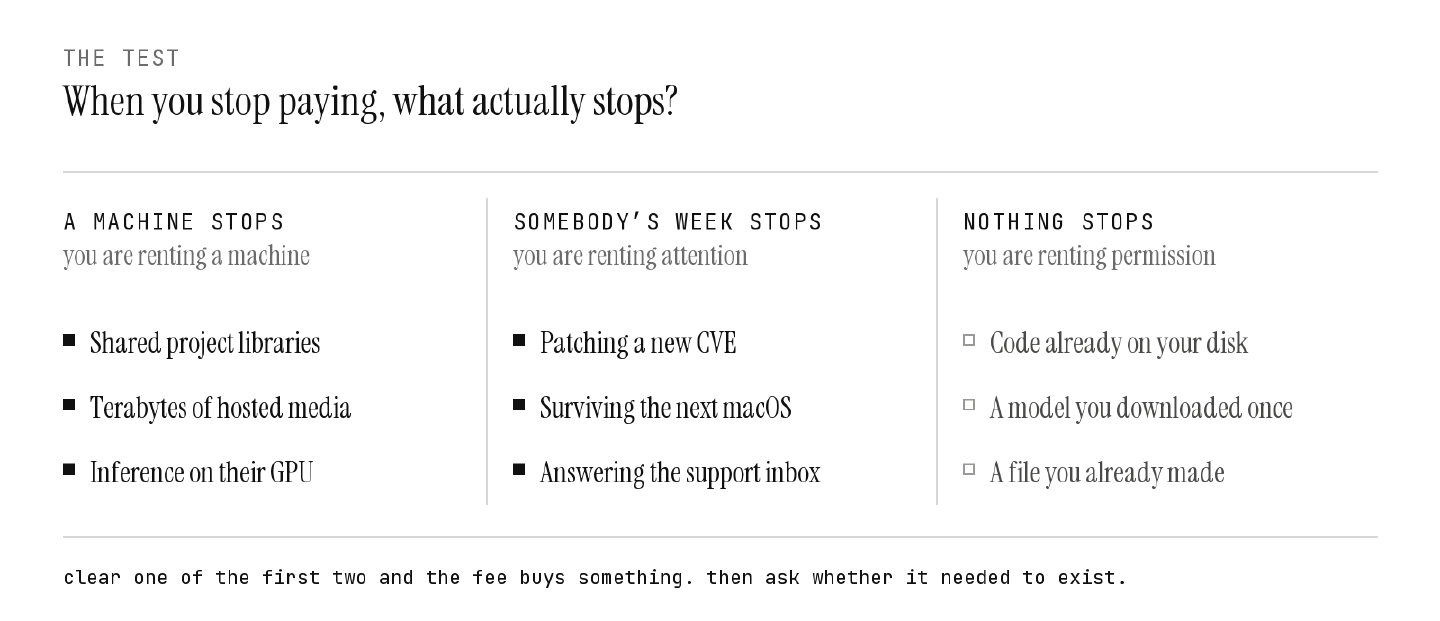
That distinction is what makes Blackmagic legible. $295 buys the program. Blackmagic Cloud is $5 a month to host a shared project library and $15 per terabyte per month for media, which is disks and bandwidth in somebody else’s building. The $30 rental buys the program by the month, on a personal profile or a company one. Three prices, three different things, none of them pretending to be another.
Now run it on Creative Cloud, since that is the case I spent a whole section on. Parts of it pass without argument. Firefly generations happen on Adobe’s GPUs, and inference costs money per image. Fonts and libraries sync through Adobe’s servers, and that storage is real. But the part I use most is Photoshop, opening a local file, running local filters, on hardware I bought. That clears the second half of the test and not the first. Real maintenance, no infrastructure. And the bill does not distinguish between them. It is one number, and the number will not tell me which half I am paying for.
Which is where the test needs a second question after the first one. Not only: does something stop? Also: did it have to be running at all?
That one sorts things fast, and not in my favour every time. Paying monthly for Claude or Gemini or ChatGPT is completely reasonable, because the compute is not on my desk and it is never going to be. Paying for Google Drive is reasonable, because I want somewhere that is not my house for a file to sit where other people can reach it. Those are services in the plainest sense of the word. I need a machine that is not mine, and somebody is running one.
Now put Arc Studio and Photoshop side by side, because they clear that first half for opposite reasons and end up in the same place.
Arc Studio is in the browser, so of course a machine stops. That is the strongest thing anybody can say for it. It is also why it is the cleanest example of the problem, because the machine is only in the picture at all since somebody decided to put a text editor on it. Formatting a screenplay does not need a remote computer. Word processors ran locally for forty years and the job did not get harder.
Photoshop goes the other way. It is still a download, still running on hardware I bought, and when I stop paying it is the program on my own disk that stops. Almost nothing on Adobe’s side goes quiet.
Two opposite architectures, one identical outcome. Cancel, and the work stops. In one case because the work was moved onto somebody else’s computer. In the other because permission was withdrawn. Neither has much to do with a computation that needed a data centre.
So that is the complaint. Not that the fee recurs. That the fee is undifferentiated, and being undifferentiated is what lets it be priced against something other than what it costs.
The app writing this sentence
Which brings me back to the advertisement.
Here is the part I got wrong when I started writing this, and it turns out to be the most interesting thing in the piece. That product does not run on my laptop. The audio goes up to their servers, the model runs there, the text comes back down. So it passes my own test cleanly. Cancel the subscription and a GPU somewhere really does stop working on my behalf. The fee buys something.
It still should not exist.
The model is small. That is the entire point. OpenAI released Whisper under an MIT licence in September 2022, weights included, and the quantised builds that Mac dictation tools ship are under a gigabyte. They run on a Mac with 8GB of shared memory without complaining. There is no computation anywhere in that round trip that my own laptop cannot do, and my laptop is already switched on.
So the round trip is not a requirement. It is a decision. Somebody looked at a job that runs locally, put a server in the middle of it, and now the server is the reason the fee is monthly. The infrastructure is real. The bill is real. Neither of them had to be there.
Which is the second question in its purest form. Does something stop? Yes. Did it have to be running at all? No. Renting a machine you need is a service. Renting a machine somebody inserted between you and a computation your own hardware could do is the same toll as before, with a receipt attached.
Now the part I have to be careful about. Setting my side of this up cost an afternoon, and that is the sentence I would attack if somebody else had written it. It was an afternoon for me. I compile things for a living. I already knew Whisper existed and I knew what to search for. For most people who buy that subscription it is not an afternoon, it is never. The honest description of most of that product’s value is that it closes a gap in knowledge, not a gap in compute.
Fine. That gap is real and closing it is worth money. So is the packaging, the hotkey handling, the per-application text insertion, the dictionary of proper nouns. And so, taking my own test seriously, is keeping all of it working through the next macOS, answering the inbox, and evaluating whatever replaces Whisper next quarter, because in this category the models genuinely do keep moving. None of that is free. None of it involves a server either.
So charge for it. Charge once for the program and for the gap it closes. Charge a maintenance fee for the years of keeping it alive, name it as such, and size it against the work. Charge again when there is a version worth charging for.
What I object to is the single undifferentiated monthly number, because that number is not derived from any of those costs. It is set against what the alternative would have cost me had I known it existed. I did not, and that is the entire pricing power. It is a business that works right up until the buyer finds out.
What I am actually asking for
Three prices instead of one. I would rather have them itemised than cheap.
Sell me the program once. Meter the parts that consume your machines, storage and sync and hosted inference, plainly enough that I can decline what I do not use. Charge a named, proportionate fee for keeping the thing alive: patches, compatibility, the inbox. And when you have built a version worth buying, ask me to buy it, and let my answer be a real answer.
I am not going to claim this makes as much money as the alternative. Adobe’s numbers settle that argument, and I put them above rather than around them. What I will claim is that each of those three prices is derived from something real. A build, a machine, a year of somebody’s attention. The single monthly number is derived from whatever the market will bear. Blackmagic runs a version of this, and Blackmagic is not a charity.
What we lost when nobody had to ask the question any more was not the money. It was the moment, every couple of years, when a company had to stand in front of the people paying for its work and make a case. That was the only mechanism this industry ever had for forcing itself to become genuinely better rather than continuously slightly different.
The dictation dropped one word in the last twenty minutes, and it was my fault. I mumbled. It has not once asked me for a card.